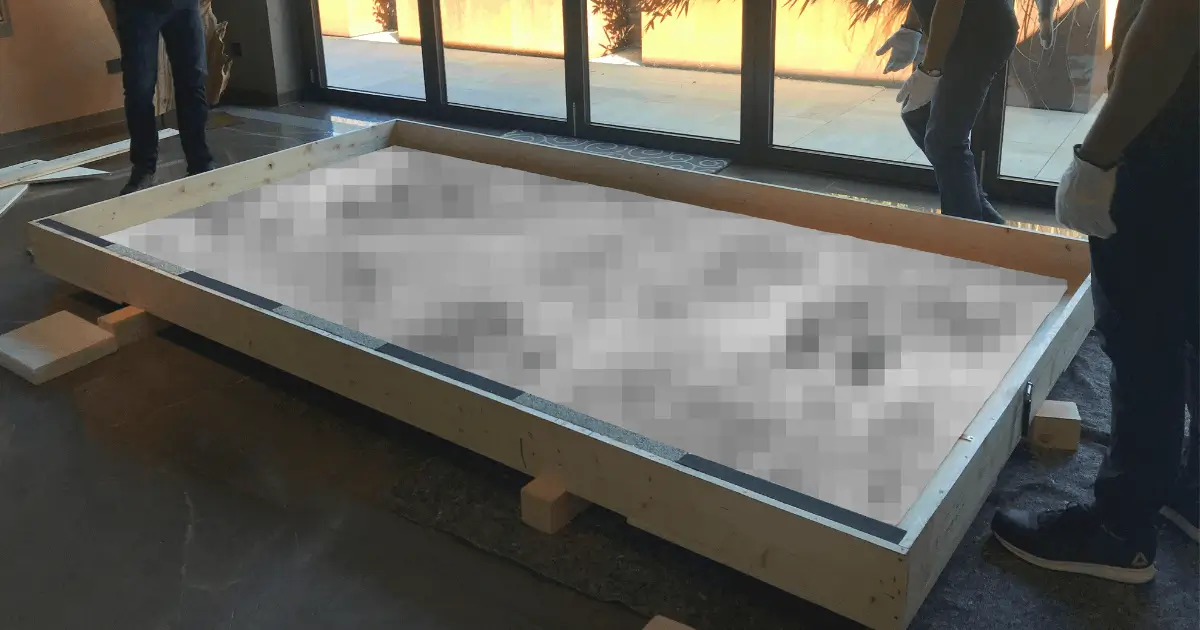
Coordination of an artwork loan for an exhibition in Belgium
This service is designed to complement the package you offer your own client, not to compete with it.

Supervision is not a line you add to a booking to feel safer. It is a person standing next to your art crate at the three key handling stages when it is being prepared to be shipped by air freight. This guide walks art freight forwarders through an import and an export at Luxembourg Airport, step by step, plus the reporting, the temporary storage rules and the courier handling that come with them.
Every art forwarder knows that incidents rarely happen while the plane is in the air. They tend to happen on the ground, in the few minutes when crates come off an airline pallet or ULD, or when a build-up team decides how to strap down an oversize crate it has never seen before. Those minutes belong to people who move general cargo all day, and who have no particular reason to know that the plywood box in front of them behaves differently from a pallet of car parts.
Supervision closes that gap. Fortius Art Logistics works one freight zone, Luxembourg Airport, and nothing else. When your shipment lands or departs here, we are in the handling area and on the tarmac at each critical step, we document what happens, and we keep you up-to-date on events as they happen. This article describes exactly what that looks like, in both directions.
Supervision means physical presence during the critical handling operations, for any shipment moving in or out of Luxembourg Airport. It applies whatever the airline. Cargolux is our reference carrier and the one you will most often be booked on, but supervision is not tied to a carrier. If your freight moves through this airport, we can be next to it.
It is also not a bundle. Airport Supervision is the most common entry point into our toolkit, not an obligation attached to anything else. Plenty of shipments come to us as supervision only, with the forwarder keeping the road transport, the air booking and the customs work. Others come to us as customs only. You choose the scope, we quote what you asked for and we do not push the rest.
There are two important limitations to our supervision service. Fortius cannot offer long-term storage for airfreight and does not operate a secure truck parking at or near the airport. Storage at the airport exists as a transit buffer between two steps, on a 24 to 48 hour horizon, and we explain the limits below.
An inbound shipment consists of three phases happening on the ground. We are present during the entire journey and provide written evidence of our work.
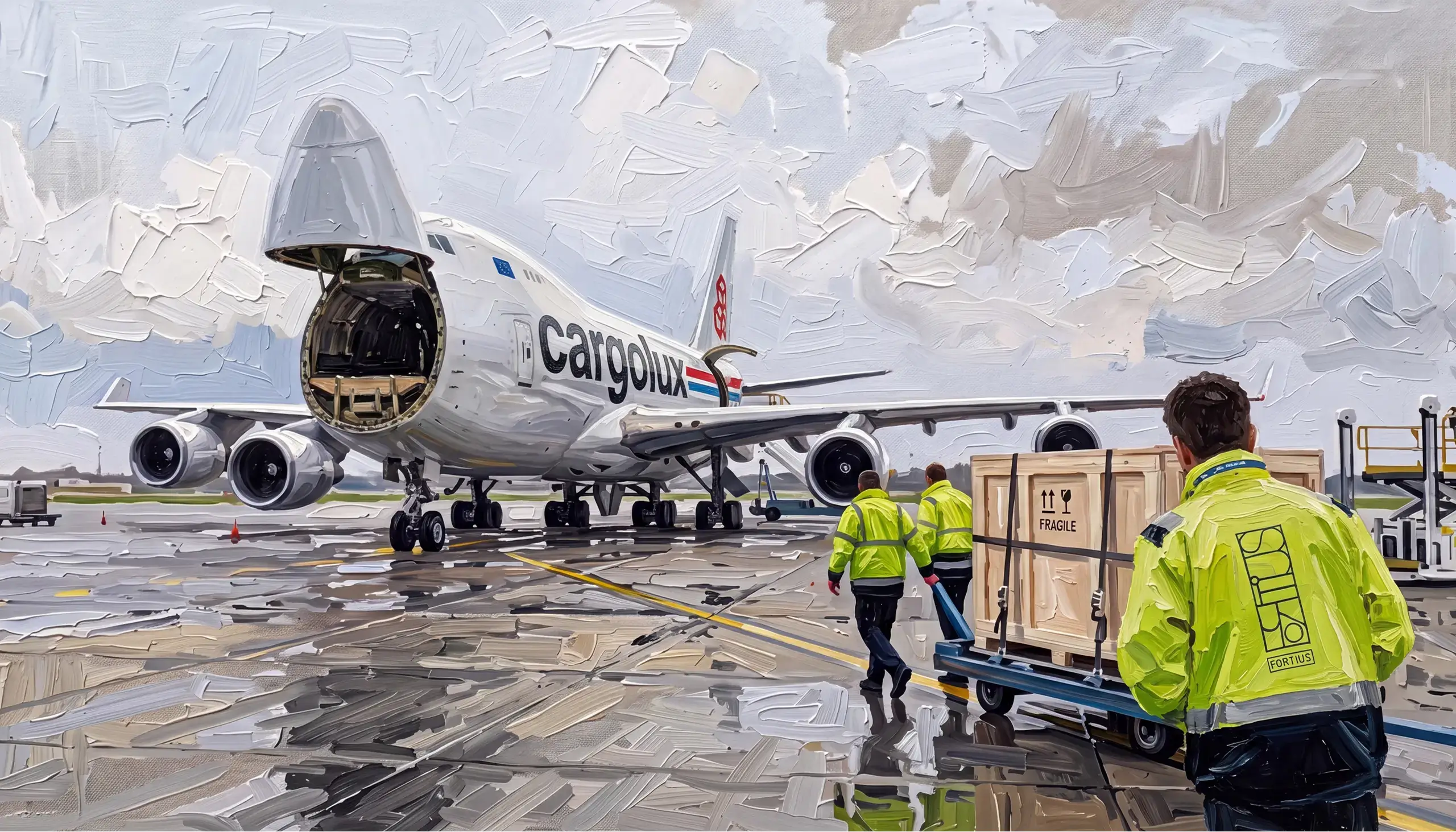
The aircraft lands and the airline pallets are unloaded from the hold and towed to the air cargo dock. This is where we start: on the tarmac, watching your freight as it comes out of the plane, not waiting for it to appear on a status screen an hour later.
What matters at this stage is knowing the airport, not watching the plane. We know which parking position has been reserved for the plane, when the handling agent will start unloading the flight, which dock your pallet will be towed to, and who to talk to when a ULD comes off in a different order than the manifest suggested. That is the difference between being informed of a problem and being there before a situation turns into one.
Your crates are split from the airline pallets at a height-adjustable ramp inside the Cargo Center. Netting comes off, straps are removed, crates are lifted clear and set down. Statistically, this is when a crate is going to be knocked, dropped, dragged or set down on a corner.
This is the step we treat as the heart of an import. We check the crate count against the AWB, we inspect each crate, and we photograph what we see. If required, we make suggestions on proper handling, for example how a crate should be lifted, which side goes down, or whether a forklift operator has the fork spread right for the skid. If a crate shows impact marks, a broken seal, water staining or a tilt indicator that has activated, it gets recorded on the spot with pictures, before the crate moves again. A condition issue documented at this stage is a claim you can actually defend. The same issue noticed three days later at the final destination is an argument.
The crates are loaded onto the truck, yours or one we arranged. We assist the driver, make sure everything is positioned and secured correctly inside the trailer, and we stay on site until the truck leaves the airport perimeter.
If your customs clearance is still pending, the freight waits in the secure area rather than on a dock, and the truck slot moves with it. We can handle the import declaration ourselves or work from the documents you provide, including transit under T1 and temporary admission under an ATA Carnet. Cultural goods paperwork follows its own logic and its own deadlines, that we describe in a dedicated guide in Customs and cultural goods compliance in 2026, and the service page on Customs and Cultural Goods.
Export runs the same three steps in mirror image, with two additional constraints that catch people out: screening, and the 48 hour unloading rule.
The truck reaches the freight zone and we supervise the unloading. We take the count, we check case condition on arrival so that the state of the freight when it entered the airport is on record, and we photograph everything.
One hard rule to plan around: an export shipment arriving by truck cannot be unloaded earlier than 48 hours before the planned flight departure. Send a truck two days early and it does not buy you a safety margin, it buys you a truck with nowhere to go. Build your road timing backwards from the flight, not forwards from the collection.
If the shipment still needs to be screened, this is the stage where it happens. At the airport, cargo can be screened by X-ray or hand search. X-ray works on most standard crates that don’t exceed a height of 150 cm and don’t contain dense material. Hand search is used to secure all other crates, but requires them to be opened in the cargo zone in less than ideal conservation conditions. In both cases, we supervise the handling, including opening and closing.
Whenever possible, we recommend delivering the cargo already secured, or asking us to organize the screening by sniffer dog. This happens off-airport at a partner facility, so it requires some planning and the use of a trucking company certified as a regulated agent. The three methods are compared on our service page about Freight Securing.
Your crates are built up onto airline pallets. We stay next to the operation and we watch three things: positioning, strapping and protection.
Positioning decides everything else. Orientation has to respect the crate markings, weight has to sit where the pallet can carry it, and nothing goes on top of a fine art case that was not built or booked to be stacked. Contour matters too. A crate that breaks the pallet profile will be re-handled later, airside, by people who did not build it. On oversize crates, the build-up requires some negotiation. The presence of our supervisor, who knows the shipment and the handling team, significantly increases the chances for a positive outcome.
Size limits are worth checking before you book rather than at build-up. Crates above 3 metres in height do not fly, and going beyond 6 metres long or 2.4 metres wide can trigger special loading surcharges. Further detail on questions about bookings, service levels and routing can be found on the Air Transport page.
The finished pallets move airside and are loaded onto the aircraft. We follow them, and we stay until the aircraft departs.
Staying to the end is not ceremony. Flights get rescheduled or delayed, loads get reworked, a pallet gets offloaded for weight and balance and rebooked on the next rotation. If that happens while nobody from your side is present, you find out from a tracking update the following morning. If it happens while we are there, you get a message, the freight goes back to a secure area instead of sitting on a pallet transporter, and we work the rebooking with the airline.
Export customs has to be cleared before departure, and where a cultural goods export licence applies it has to be presented and discharged before the freight leaves. We prepare and lodge the declarations, or manage and discharge the documents you send us.
Freight can wait at the airport between two steps. It waits either in the automated rack for airfreight pallets or in the secure high-value cargo area, depending on the shipment.
Three rules govern it. Storage at the airport is generally limited to 24 to 48 hours, counted during the work week, Monday to Friday, weekends and local public holidays are not counted. Export shipments arriving by truck cannot be unloaded earlier than 48 hours before the planned flight departure. Import shipments that need to stay longer than 48 hours might incur storage charges from the handling agent, which we will tell you about before they start running rather than after.
This is a transit buffer, not warehousing, providing enough time between an arrival and loading onto a truck, or between unloading and a flight’s departure. If your shipment needs weeks rather than hours, say so early and we will point you to the right kind of facility instead of stretching an airport solution that was never built for it.
Every supervised step is documented in writing, with supporting pictures taken at each step. You receive a preliminary PDF report after every stage, and a final report for your own file once our work is done.
Between reports, you get what you need in the channel you actually use. Instant updates through messenger apps during the operation, for the coordinator who needs to tell a client that the truck has left the airport. And if you run an electronic supervision platform, we plug into it and report inside your system rather than asking you to reconcile two sets of records.
The point of documented reporting is not the paperwork. It is that six weeks later, when a condition question surfaces at the far end of the chain, you have timestamped pictures of that crate during pallet splitting and a written record of who handled it and how. That evidence is either created on the day or it does not exist.
High-value loans usually travel with a courier, and a courier at an airport is a logistics problem of its own. Access is controlled, the cargo centre and the passenger terminal are two different buildings, and a courier who cannot reach the handling area is a courier who won’t sign a condition report they never witnessed.
We handle the whole sequence, from the courier being present at breakdown or build-up rather than waiting in a lounge, through transfer between the Cargo Center and the passenger terminal, to hotel and restaurant bookings when the schedule requires an overnight stay, and the flight booking itself, whether the courier flies out on the cargo aircraft with the works or returns on a passenger flight the next day.
For museum registrars and their forwarders, the way every part of this puzzle fits together decides whether the operation feels controlled or improvised.
Two situations are worth agreeing on before they happen.
A schedule moves, a flight is rebooked, a pallet offloaded or a truck is stuck at the border. We tell you as soon as we know, put the freight back into a secure storage area rather than leaving it in the open warehouse, and we come back to you with solutions including their downsides rather than with a problem. Operations run late, and we stay reachable outside office hours when they do.
A crate that needs our attention. We stop, we photograph, we record the finding at the point of discovery, and we do not let the crate continue until the condition is on record. Then we tell you, with pictures, so you can decide whether to open, hold or move on. We do not open a crate on our own initiative, and we do not quietly forward a crate that we know is compromised.
Send us the details you have as soon as the booking is confirmed. The sooner we are in the loop, the more room we have to arrange slots, trucks and screening around your flight.
To get started, we need to know the origin or destination of the shipment, the (desired) date of the flight and the number of crates and their dimensions. We are aware that you may not have definitive information for all these items, so give it your best shot. From there you get a fixed quote for the shipment and a response within 24 hours on business days.
Then we qualify the shipment with a short set of questions, because the answers change the price and the plan more than anything else does. We might follow up with further questions on other elements that influence the price and the schedule.
The quote comes as a fixed price for the shipment, with the scope of work attached, the crate count fixed and the cancellation terms written down. If the details of the shipment change, we adapt our quote and our solutions to fit your requirements.
Field knowledge. More than ten years on one tarmac, 57 supervised operations in 2025, and a team that knows the handling agent, each dock and each procedure at this airport. Depth on one site beats coverage across ten. Luxembourg Airport also has structural advantages for high-value freight, from freight zone access to full freighter capacity, which we cover in Why fine art moves through Luxembourg.
Physical presence. We don’t supervise from behind a screen. Our team stands next to the crates at each step, which is the only position from which you can actually stop something.
Documented reporting. Written record and pictures at every step, a preliminary report per stage, a final report for your file, live updates in your channel and integration with your supervision platform.
Courier handling. Access to every step, cargo centre to passenger terminal transfer, and the full travel arrangements around it.
Most importantly for our partners, we are neutral by design. No corporate group behind us, no offices chasing volume in your markets, no reason to ever contact your client. Your shipment stays your shipment, and your client stays your client.
GO FURTHER
Send the origin or destination, number of crates and shipment date. We will tell you how we would run it, and what it would cost.
This service is designed to complement the package you offer your own client, not to compete with it.
Luxembourg Airport is built around cargo, not passengers, which is what makes it worth a second look for fine art. It is not always the cheapest way to fly a standard crate, but for a defined set of shipments it is the most workable option, covering crates a passenger aircraft will not accept, volume on […]
Written for art freight forwarders and logistics coordinators who move cultural objects into the EU, out of it, or both. Whether you already know the EU rules well or know your own country’s rules better than we ever will, this is our take on how the two sides fit together, and where we think we […]