Coordination of an artwork loan for an exhibition in Belgium
This service is designed to complement the package you offer your own client, not to compete with it.

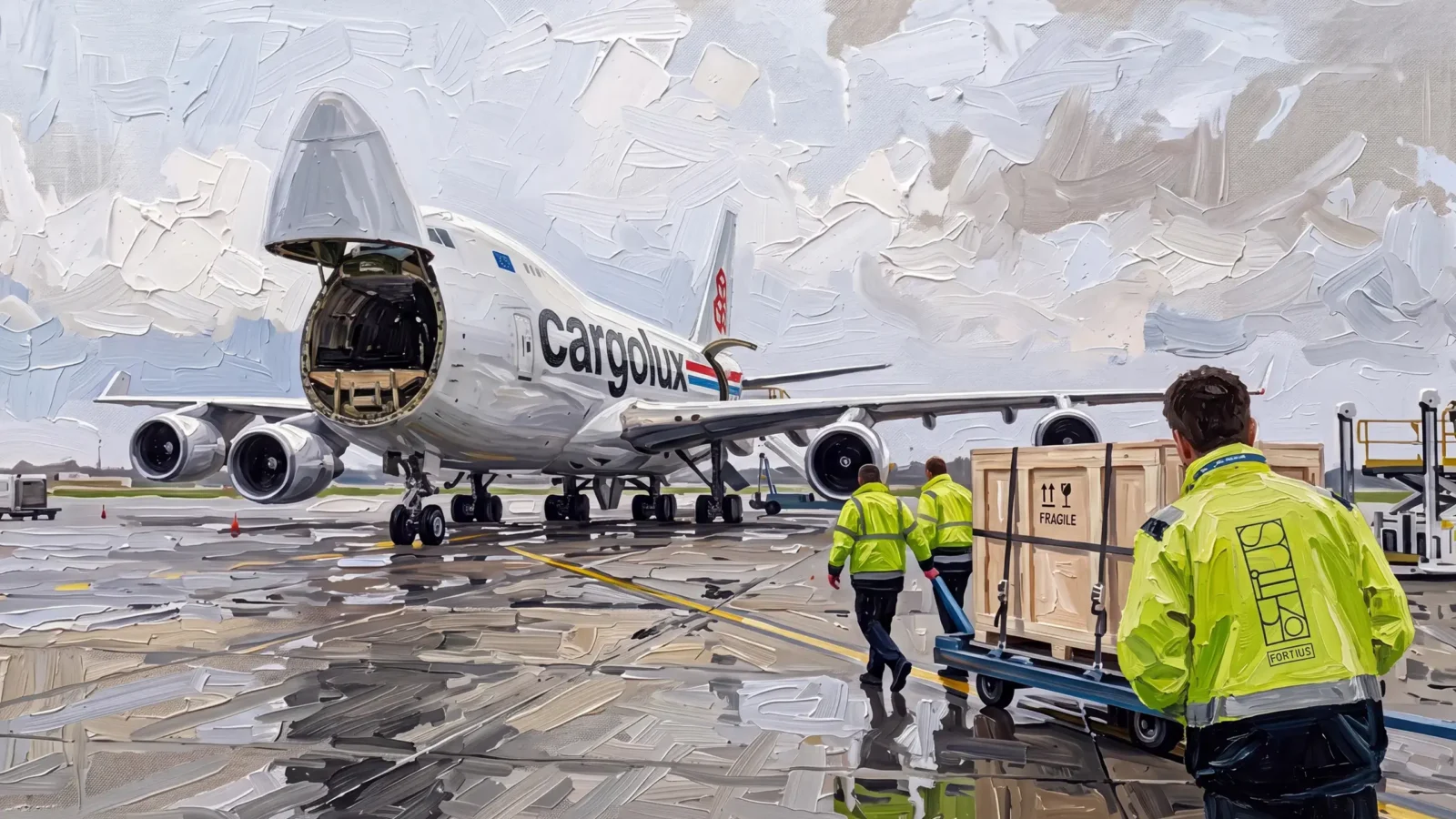
Luxembourg Airport is built around cargo, not passengers, which is what makes it worth a second look for fine art. It is not always the cheapest way to fly a standard crate, but for a defined set of shipments it is the most workable option, covering crates a passenger aircraft will not accept, volume on lanes where Cargolux has spare capacity to fill, and shipments where you want an all-cargo operation from truck gate to main deck. Here is how it actually works, where it stops making sense, and what Fortius Art Logistics adds on the ground.
As a passenger airport, Luxembourg is of regional interest at best, and pales in comparison with big passenger hubs like Amsterdam, Frankfurt or Paris. Airfreight is its real strength. Public airport and industry figures put it at roughly 830,000 tonnes of cargo in 2024, consistently inside Europe’s top ten for freight, on an airport with a single runway and a modest passenger terminal.
That ratio is the whole point. In a large passenger hub, an art crate is a fragile, awkward, high-attention item competing for the time of teams whose day is structured around boarding, baggage and passenger security. Here, the freight zone is the airport’s core business, so reaching it and working in it is faster and less negotiated. High-value shipments are handled by an operation built around added value rather than around volume, which matters most when operations go wrong, for example a delayed truck, a crate that needs re-strapping, or a courier who has to reach the handling area before the pallet moves airside.
Structural advantages of this kind only become value when someone is standing next to the crate. That is the part Fortius Art Logistics covers, with 59 tonnes of art freight booked and supervised through our airport in 2025, and airport supervision as the entry point to everything else.
Air freight is priced per chargeable kilo, and rates follow capacity. Competition on price is much more intense on easy shipments, ones that palletise easily, are neither too heavy nor too big, and can also fly in the belly hold of a passenger aircraft. Cargolux, the reference cargo carrier at our airport, flies all-cargo Boeing 747 freighters, with up to 3m of main-deck height and belly capacity limited to around 160cm, the same limit that applies on the largest passenger aircraft. The difference is competition. At other airports, cargo capacity comes from several airlines, on both passenger and freighter aircraft. At ours, most of that capacity runs through Cargolux alone. If price is the only consideration, Luxembourg will often not be the cheapest option, and that is worth saying to your client rather than pretending otherwise.
While we are removing arguments, redundancy is not a local advantage either. Freighter capacity at our airport runs almost entirely through Cargolux, so if their schedule or space does not work for your shipment, there is no second all-cargo carrier here to fall back on, the way there would be at a larger, multi-airline hub.
What is left after those two arguments are gone is narrower, more specific, and considerably more useful.
Crates a passenger aircraft will not take. Belly holds are limited by their own height and, more often, by the door aperture. Above 160cm in height, freight will not physically fit in the belly holds on even the largest passenger planes, so if a crate is too high to be loaded into the belly, you will not get a rate to ship it there at all. A freighter main deck changes the arithmetic entirely. Through Luxembourg, plan on a maximum crate height of 3m, and keep the crate under 6m long and 2.4m wide to avoid triggering special-load surcharges that will undo any rate advantage you thought you had. That envelope covers most monumental work, including large-format canvases in A-frames, sculpture, and crated installations. Fortius has over ten years of practical experience handling large and heavy paintings and sculptures through Luxembourg Airport.
Volume on lanes where the freighter needs return freight. Cargolux flies rotations, but also point to point, depending on the cargo bookings across its global network, and demand is not balanced in both directions. Demand for airfreight from Asia into Europe runs high, so Cargolux operates a large number of weekly flights on that lane, which keeps rates competitive and scheduling flexible both ways. For North America it works the other way. Demand from Europe to the United States is much higher than the reverse, so a shipment from Luxembourg to New York typically costs more than the same shipment from New York to Luxembourg, simply because there is more demand heading out of Europe. Send us the origin, destination and dimensions before assuming a lane is expensive.
Shipments where you want an all-cargo operation. There is no passenger flight cancelled and rebooked with your crate three days behind schedule, no offload in favour of luggage, and no mixed-priority terminal. For a shipment tied to a fair opening, an exhibition install or a loan return date, schedule stability is worth more than a few cents per kilo.
If we do not think we can be competitive on your shipment, we will tell you. If we think it should fly from another airport, or with another airline, we will tell you that too. When we do send you a quote, it is because we believe our plan is competitive and makes sense, even though you may still prefer a different option.
The main lanes out of Luxembourg are the United States, Asia and the Middle East, with several flights a week on each. Cargolux also serves more exotic locations, such as Johannesburg in South Africa or destinations in South America. Flights are less frequent and not all regions are covered, so check with us if we can book a suitable flight.
Fortius only books export shipments departing from Luxembourg, through our air transport service. If necessary, we organise the trucking to Luxembourg first. For import shipments, the airfreight is booked by the agent at origin, and Fortius acts as the receiving shipper, handling the formalities in Luxembourg (see our compliance pillar on cultural goods and customs) and onward transport to the final destination.
Cargolux organises its products by commodity type rather than by a single generic tariff. For artwork, that means a choice between two products, plus an optional add-on.
CV Classic, general cargo in everyday terms, is Cargolux’s standard product and the lowest rate on a given lane. It carries no priority at build-up or at loading. In our line of business, it is a defensible choice for lower-value artworks, when cost is the deciding factor despite the downsides.
CV Precious is the product built for artwork and other sensitive high-value cargo. It buys priority over CV Classic, dedicated handling teams, handling tailored to flight direction and G-force, segregation from other cargo with no mixing with liquids or dangerous goods, supervised build-up, and secured storage between steps. A courier can accompany the shipment on an upper-deck seat, booked and arranged separately by Fortius when a shipment departs from Luxembourg. What matters here is that a mainstream freight carrier maintains a documented procedure for art at all, which is not the norm.
CV Precious has one honest limit. It does not outrank everything on the aircraft. Healthcare, pharmaceuticals, live animals and perishables take priority over it.
Select is a paid add-on available on both CV Classic and CV Precious. It gives priority over non-Select shipments in the same category, and you can add it whenever your client needs it, the same way you can selectively book whichever Fortius services complete your own offer to your client.
The product only performs if the local execution is right. Build-up supervision, correct labelling, a booking that reflects the real dimensions, and documents that match the crate all have to be right. Get one wrong and CV Precious becomes an expensive CV Classic booking. A forwarder in Paris or Milan does not need to learn Cargolux’s art procedures. That is what we are for.
Cargo activity at Luxembourg Airport happens in one building, next to the aircraft parking positions, run by a single handling agent, Luxcargo Handling. The entity was created when Cargolux acquired Luxair’s airfreight ground-handling activity, formerly known as Luxair Cargo, and brought it under one roof alongside the rest of cargo operations. There is no coordination across competing ground handlers, no shuttle between terminals, and no shipment that stalls because two operators disagree about who has the crate. The cargo apron was extended in 2017 and 2018, adding four parking positions for a total of twelve, which tells you where the airport puts its capital.
For a crate, having everything in a single location means a short, continuous path from truck gate to handling area, pallet, airside and aircraft. For a courier on a museum loan, it means the handling steps are physically reachable, and the transfer between the Cargo Center and the passenger terminal is a short run rather than an expedition. None of it is automatic. Someone has to be there at each step, with the right access, at the hour the pallet actually moves. Our airport supervision service exists for that, and the full sequence appears in our step-by-step supervision guide.
We do not offer this same level of detail across ten different sites. We built it for Luxembourg Airport alone, which is exactly why it goes this deep on one.
Every air export has to be screened before departure. How it gets screened is an important decision, and it is one of the better reasons to look at Luxembourg.
X-ray in the cargo zone is non-invasive and keeps the crate sealed, but it stops at 150cm of height and is not suitable for dense materials such as metal or stone. Manual control works on anything, with no size limit, at the cost of opening the crate at the airport, taking trace samples from the packing, and occasionally partially unwrapping the artwork, in conditions that are not conservation-grade. Both happen at our airport and we supervise both.
The third route avoids any disadvantages of these other methods. Sniffer-dog screening takes place at an external partner facility in France, about an hour from our airport and on the way there, before the crate is delivered to the terminal. There is no opening, no height limit, and no density problem, and the crate arrives at the airport already secured. This also does not cost your client more. Securing at the airport and securing at the partner facility are priced the same, and Fortius handles the booking directly, so there is no extra work on your side either.
In most cases we organise the trucking and the securing together, so the client has nothing to plan around. The stop happens on the way to the airport, not as a detour, and the extra time comes mainly from processing at the facility rather than from the distance. We agree on the method well ahead of the shipment, as part of planning it with the client. If nothing is specified in advance, which is rare, the cargo is simply secured at the airport instead. Securing at our partner facility requires that the road transport is performed by a regulated agent. If your company or your trucking partner does not hold this certification, we can arrange transport with a regulated partner on TAPA/TSR certified, climate-controlled trucks.
The advantage of securing before arrival is straightforward: you are guaranteed that the crate will not be opened in a setting that is not suitable for artworks. Since 2025, Fortius has secured 18,000 kg at our partner facility. A full comparison of the three methods is on our freight securing page.
Luxembourg is located at the crossroads of France, Germany and Benelux, putting every major continental art market within a working day by road. That central location is a real asset, and Fortius has the network to make full use of it. Through our partners, we book specialised fine art transport in and around Luxembourg on dedicated or groupage trucks, and on TAPA/TSR certified thermo trailers taking up to 3m of load height when the securing chain requires it. Local pickups and deliveries across Luxembourg are part of the same road transport offer, whether the artwork is going to a gallery, an institution or a private address. Beyond Luxembourg, reciprocal partners abroad extend that same network further, customs formalities handled in the Netherlands, delivery and installation handled in New York, giving a forwarder with no presence here a complete door-to-door offer.
For completeness, Luxembourg also hosts a high-security storage hub at the airport, part of the country’s high-value goods infrastructure alongside its air cargo activity.
Fortius Art Logistics is independent, not part of an international group with its own offices in your market. Route a shipment through us and there is no risk that we use it to approach your client directly in Frankfurt, Paris or anywhere else. We depend on the same kind of reciprocal partners abroad for our own shipments, so neither side has an incentive to compete with the other.
The history is short and it matters. Our team has worked the freight zone of our airport for more than ten years, first inside a Swiss group, independent in Luxembourg since 2017 when the group changed hands, and fully in the hands of its two directors since the management buy-out of 2024. It has been the same apron and the same procedures throughout, with no group politics layered on top. There is more on that on our about page.
Fortius is neutral by design. It is the least visible of Luxembourg’s advantages, and for a competing forwarder, it is the one that makes all the others usable.
GO FURTHER
Send us the shipment details, with the flight number, AWB and crate count if you already have them, and we will tell you if we can assist you, what we can add to improve your service to your client, and what our service would cost. We respond within 24 hours on business days.
This service is designed to complement the package you offer your own client, not to compete with it.
Supervision is not a line you add to a booking to feel safer. It is a person standing next to your art crate at the three key handling stages when it is being prepared to be shipped by air freight. This guide walks art freight forwarders through an import and an export at Luxembourg Airport, […]
Written for art freight forwarders and logistics coordinators who move cultural objects into the EU, out of it, or both. Whether you already know the EU rules well or know your own country’s rules better than we ever will, this is our take on how the two sides fit together, and where we think we […]